AI is already transforming investigations by accelerating review, revealing patterns at scale, and surfacing connections that once took weeks to uncover. In high‑stakes environments such as the life sciences industry, where scientific context, regulatory exposure, and subtle indicators of misconduct matter, expert judgment is what turns AI‑generated signals into insights that are accurate, defensible, and operationally meaningful.
AI can accelerate the path, but expertise determines the destination. It is an investigative and subject matter expert in the loop—someone who understands nuance, challenges assumptions, and knows how to interpret and connect both the data and the AI.
As our teams at Control Risks deploy Relativity aiR across global investigative matters within the life sciences industry, one conclusion has become unmistakably clear: AI accelerates the mechanics of review, but it is the judgment, context, and intuition of seasoned investigators that determine whether those outputs become meaningful and defensible.
This is especially true in the pharmaceutical and biotechnology industries, where investigations often involve:
- Intricate scientific data
- Evolving regulatory frameworks
- Highly specialized risk profiles
In these environments, AI can rapidly surface patterns and anomalies. Investigators with sector-specific expertise can help interpret those signals, distinguish the significant from the incidental, and translate findings into insights that withstand scrutiny from regulators, courts, and internal stakeholders—offering a significant benefit to case teams.
Where Enforcement and Investigations Collide in Life Sciences
Investigations in pharma and biotech rarely occur in isolation. They sit at the intersection of multiple legal and regulatory requirements, such as fraud and abuse (for example, False Claims Act (“FCA”) and Anti-kickback Statute (“AKS”)) and anti-corruption (for example, Foreign Corrupt Practices Act (“FCPA”)).
The stakes are high. Missteps can trigger government inquiries, whistleblower litigation, or cross-border enforcement actions that affect not just balance sheets but reputations and careers. AI can help teams find more of what matters, faster. Deciding what “matters” in this context is a legal and investigative judgment call, not an algorithmic one.
What AI Does Best and What Only Investigators Can Do
AI-enabled platforms such as Relativity aiR are powerful force multipliers in this environment. They can:
- Ingest and process millions of documents and records at speed
- Detect anomalies, patterns, and clusters in structured and unstructured data
- Surface potential relationships between people, events, and transactions
- Highlight outliers that warrant closer review
Experienced investigators and subject‑matter experts, meanwhile, remain essential. Because of their experience and continuous pulse on the industry, these professionals accomplish critical strategic work by:
- Framing the right investigative questions and hypotheses
- Interpreting patterns in a regulatory and scientific context
- Distinguishing meaningful signals from background noise
- Deciding which leads to pursue and which to deprioritize
- Connecting evidence into a coherent narrative that stands up to scrutiny
While AI accelerates the mechanics of an investigation, investigators determine the direction, meaning, and defensibility of its outcome.
Case Study: Using Relativity aiR to Expose Falsified Healthcare Provider (“HCP”) Attendance Records
Control Risks recently carried out a detailed internal investigation for a European pharmaceutical company following allegations of misconduct within its Mexico-based sales team.
The allegations
An anonymous whistleblower reported that the local sales manager and several members of his team had been falsifying documentation related to meals and interactions with healthcare professionals (HCPs). According to the report, the team:
- Routinely added the names of HCPs who had not actually attended certain dinners or promotional events
- Inflated the number of attendees to artificially lower the calculated per-person spend
- Made events appear compliant with the company’s strict limits on Transfers of Value (“TOVs”) to HCPs
The approach
To assess the credibility and scope of these allegations, Control Risks conducted a comprehensive review of both structured and unstructured company data.
Structured data included expense reports, attendee lists, and other financial data. The team collected and analyzed unstructured data using AI‑enabled review tools within RelativityOne. That unstructured data included emails, messages, calendar entries, and other internal communications.
This approach allowed investigators to efficiently identify patterns, inconsistencies, and communications that suggested coordination among team members.
What AI surfaced and what investigators concluded
The AI-powered review proved critical in uncovering evidence that the sales manager and his team had directed or approved the falsification of attendance records across multiple events. The investigation revealed:
- Repeated instances where spouses of attending HCPs and non-attending HCPs were added to meal documentation
- Internal communications indicating awareness that these practices were being used to circumvent spending caps
- Clear violations of company policy governing payments, meals, and other TOVs to HCPs
- Misconduct occurring at several levels of event planning, reporting, and approval
AI helped surface the patterns and inconsistencies at scale. Investigators with industry-specific knowledge connected those patterns to policy obligations, regulatory expectations, and potential enforcement exposure.
Designing Effective AI Prompts for Life Sciences Investigations
When it comes to leveraging AI in investigations, the quality of your prompts can make or break the outcome. A well-constructed prompt does not simply ask the AI to “find relevant documents.” It frames the request with investigative precision, context, and hypotheses. Poor prompts tend to be vague, overly broad, or disconnected from the substance of the matter, which leads to noise instead of insight.
To help you get the most from Relativity aiR in your life sciences, pharmaceutical, and biotech investigations, here are some quick tips:
- Avoid vague asks. Specific requests and details will help uncover what you need to know.
- Don’t use “Find relevant documents.”
- Build targeted prompts tied to specific allegations, timeframes, roles, and geographies.
- Frame prompts with investigative context, just like you would for a human investigator on your team.
- Include allegations and theories of liability.
- Reference applicable statutes or regulations such as FCA, AKS, or FCPA.
- Note the time periods, business units, and product lines in scope of your investigation.
- Account for dense and inconsistent nomenclature. You can help cut through the noise by minimizing jargon and pointing out what matters more directly.
- Pharmaceutical and biotech matters often involve:
- Extensive abbreviations, some standardized and some company-specific.
- Product names and internal codes.
- Study identifiers, trial names, and protocol references.
- So, before crafting prompts, investigators should:
- Identify relevant abbreviations, synonyms, and contextual distinctions.
- Teach the AI how these terms are actually used within the organization.
- Instruct the model on how to compare or disambiguate similar terms during review.
- Pharmaceutical and biotech matters often involve:
Doing this work up front helps ensure that your AI tool recognizes internal terminology correctly, reduces false positives, surfaces the right signals more consistently, and produces outputs that are accurate, relevant, and defensible.
Teaching AI How Your Organization and Regulators See the World
AI models are only as effective as the context and direction they are given. When developing prompts for an investigative matter using aiR for Review on specific data and documentation, nuance matters.
Consider how the same allegation can require different analytical lenses depending on the surrounding environment. For example, an allegation of an inappropriate TOV to an HCP requires a different lens when the individual is based in a country with a national healthcare system or the HCP is employed by a government-owned healthcare organization.
In those situations, the same underlying conduct may carry:
- Domestic fraud and abuse implications
- FCPA or other anti-corruption exposure
- Heightened scrutiny from both healthcare regulators and anti-corruption authorities
Developing effective AI prompts, workflows, and quality controls in this environment demands more than technical proficiency. It requires subject‑matter expertise in relevant laws, regulations, and enforcement trends; sound investigative judgment about what patterns may be meaningful; and awareness of how regulators and internal stakeholders are likely to interpret the same evidence.
The Future of Investigations: Human Judgment and AI
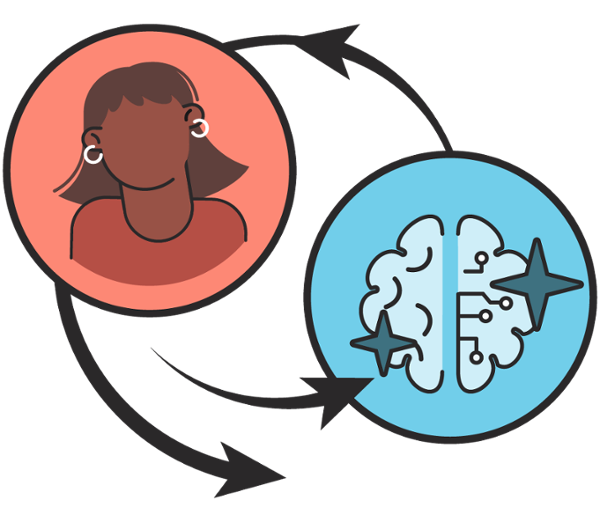
The future of investigations is defined not by a choice between artificial intelligence and subject matter experts, but by the strength of their partnership. When we place an experienced investigative professional at the center of an AI-enabled process, we transform it into a force multiplier.
In that model:
- Human judgment sharpens machine-driven insight
- Machine-driven insight accelerates human judgment
Together, they create an investigative capability that is more precise, more adaptive, and more powerful than either could be on its own.
This integrated approach is already reshaping how complex matters are uncovered and investigated across the life sciences and pharma industries. It is also becoming the new standard for work that must withstand scrutiny from regulators, courts, and boards.
Graphics for this article were created by Sarah Vachlon.